Coptic Music
by Shenouda Mamdouh - Published in
Watany Weekly Newspaper dated 8 August 1993
|
Coptic Music by Shenouda Mamdouh - Published in Watany Weekly Newspaper dated 8 August 1993 |
|
For centuries, Coptic music scholars and many archeologists tried to discover the roots of Coptic Hymns... They agreed that there exists three sources which might have influenced this heritage who are: Jews, Greeks and Ancient Egyptians:Jewsplayed a big role in the spread of Christianity, from them all the Ancient Testament and many rituals were taken.
Greeks generated many Greco-Egyptian musicologists who contributed in building the actual known musical culture with it's rules, styles and forms. Musicologists as Dydimus of Alexandria, Pseudo-Demetrius of Phaleron (First Century) Claudius Ptolmy (Second Century), etc. Some old Coptic hymn manuscript (Oxyrhynchus Papyrus) was found from this age having coloured circles with different shapes and colours over the Coptic text of the hymn. It was interpretedas an ancient way of musical notation where the colours represent the toneand the shapes represent different musical lengths.
Finally, we find a big influence of Ancient Egyptian music on the church in early centuries: There exists a relationship between the Coptic Kyrie and the Ancient Egyptian traditions for the sun-god. Scholars found also the Antiphonal singing system between a group of priests and group of priestesses...Ancient Egyptians were also characterized by the melismata (singing many notes over one of the seven vowels which were called "Magic Vowels" andused to give strong feeling of piety and humility in Religious occasions) They were also characterized by using professional blind singers and some percussion instruments for religious music. It was noticed that the actual Egyptian village folklore have big similarity with the tones and rhythmsof the Coptic Music.

As it is difficult to separate the music from the civilization evolution, Coptic music passed through three essential ages:
Because the clergy were not professionals in singing, the church decided to use talented people (usually blind) in singing... The German archeologist Hans Hickmann proved that those cantors still move their hands and fingers systematically (Cheironomy) with the Coptic music as used to do their ancestor Ancient Egyptian grandfathers when conducting music in the Fourth Dynasty (2723-2563 BC) and those cantors played a big role in transferring this heritage toour day with great precision! They mastered it and considered it a sacred secret and precious treasure which should be kept for several ages to come, exactly as have done the Ancient Egyptian priest before thousands of years ago.
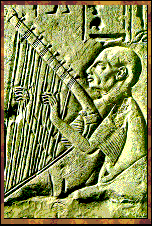
- RomanEmpire's age where Egypt sent a lot of Coptic missionaries to spread the gospel and a lot of traces left by the Theban Legion in Northern Italy, Switzerland, down the Rheine Valley and all Western Europe. As monasticismand mysticism, music also spread. We find great similarity between Ancient Latin hymns and Egyptian hymns. (e.g. Crucem tuam adoramus, Flectamus genuaand levata, etc.) and also the Ancient Egyptian harp as one of the Egyptian traces found in Ireland.
- After the Council of Chalcedon, the church was divided... Copts cut contact withall other churches except the Syrian church to keep their Orthodox faith uncontaminated. This, although unpredictable had a very positive influencein preserving the ancient musical heritage.
- TheEgyptian ability of preserving and maintaining their culture was well shown after the Arabs invasion to Egypt. All Egypt spoke Coptic until the time of HH Pope Zacharia (1004-1032) and more than that some villages in the South of Egypt remained maintaining their language until the 19th century...Until this day, a big part of the Egyptian culture is still preserved.Three writers from the middle ages described the Church rituals and hymns:Ibnel-Assal & Ibn-Saba (13th century) Abul-Barakat Ibn-Kabbar (14thcentury) and we find them the same today as described in their books.
At the time of HH Pope Kyrellos Father of Reformation (1854-1863), the senior Cantor at The Great St. Mark Cathedral in Cairo Mlm. Takla was assigned to compile the Coptic Hymns from the North to the South of Egypt along with revision and language adjustment by the assistance of Mr.Erian Moftah the professor of Coptic language in The Cairo Thological Semminary and both they suceeded to a big extent in achieving such a sensitive task. Mlm. Takla taught seven cantors all the treasure he collected. By two of those cantors thegreat Mlm. Mikhail Gerges El-Batanony cantor ofthe 20th century who will later on be very famous was instructed.
In 1927, a young man called Ragheb Moftah, invited the famous British Musician Ernst Newlandsmith and transcribed in 9 years all the Coptic Hymns in 16 volumes in modern musical notation... He recorded from Mlm. Mikhail andseveral other's voice all the Coptic Music heritage on records and tapesto preserve it from vanishing. By doing that, Dr. Ragheb Moftah inaugurated the new age of Coptic Music.
These records are considered the most precise ones in the whole world, upon which most studies were and are built. Among these studies the scholar of Ancient Egyptian music Hans Hickmann, the Hungarian ladies Ilona Borsai and Margerit Toth, the American Martha Roy and Marian Robertson. Several theses are now made on Coptic Music: Master Thesis-1975 on Coptic Music Bibliography by Salwa El-Shawan, Master Thesis-1976 by Nabil Kamal Boutros and the first Ph.D.-1986 by Nabila Erian in Baltimore County, Maryland State University.In 1989, the Coptic Encyclopaedia was compiled by the efforts of Professor Aziz Suriel Attia at Yota University and published with the most recentand elaborated information and research work about Coptic Music Studies.Another Ph.D. thesis-ICS-Cairo-1995 on the Psychological effect of Coptic Music was submitted by Fouad Asaad Attia.
What I want to stress here is that this strong and impressive music, inherited from generation to another from thousands of years began to disappear andto be influenced by the modern attractive media. And instead of being spread and used in our daily lives in your home, your car even as light musicwhen working or at least to flourish in Universities, Musical Institutes, Musicology, Ethnomusicology, Music Therapy departments and many choirs everywhere as one of the most precious and ancient music in the whole world, it is unfortunately ignored by many people and I am afraid it might dieas happened to many Ancient Egyptian secrets as building the pyramids and mummifying the human's body!